
Short answer
An ayahuasca ceremony usually consists of checking the readiness of the participants, explaining the arrangements, an organized meeting in a prepared space and a period of rest afterwards. The team monitors the state of the group and responds to requests for help. The exact sequence, music, duration and way of ending depend on the tradition and the organizer, so there is no universal script, and the specific conditions must be clarified in advance.
The description of the ceremony often begins in the evening, when people gather in the hall. In fact, a quality process starts earlier: with a questionnaire, a health talk, an explanation of the format and the opportunity to opt out. What happens before the meeting is no less important than the atmosphere in the room itself.
The order of a ceremony depends on the tradition and the organisers. This article describes the main stages and questions to discuss with the team beforehand.
What happens before the meeting starts
Prior to arrival, the organizer must gather relevant information and explain why it is needed. A meaningful pre-screening is not limited to the question "are you feeling well". It covers physical and mental status, regular medications, recent changes in well-being, and experiences of acute crises. If the answer requires professional evaluation, the retreat team should not replace the doctor.
After arrival, the participant is shown the premises, toilet, exits and rest area. The team names their roles: who leads the meeting, who stays sober, who responds to physical discomfort, and how to call a specific person. It is important that these explanations are clear even to someone who is worried or is new to the group.
Personal boundaries are discussed separately. Touch, help with movement, one-on-one conversation, or body practice should not be a surprise. Prior consent to one type of support does not mean consent to any actions during the evening. The participant should know how to say "no" and who to tell if the contact causes discomfort.
A joint conversation, a short mindfulness practice, or an explanation of the cultural context can be held before starting. This helps the group orientate, but is not proof of safety. Quality is determined not by solemn words, but by how clearly support is organized in an unforeseen situation.
How the space is prepared and the ceremony begins
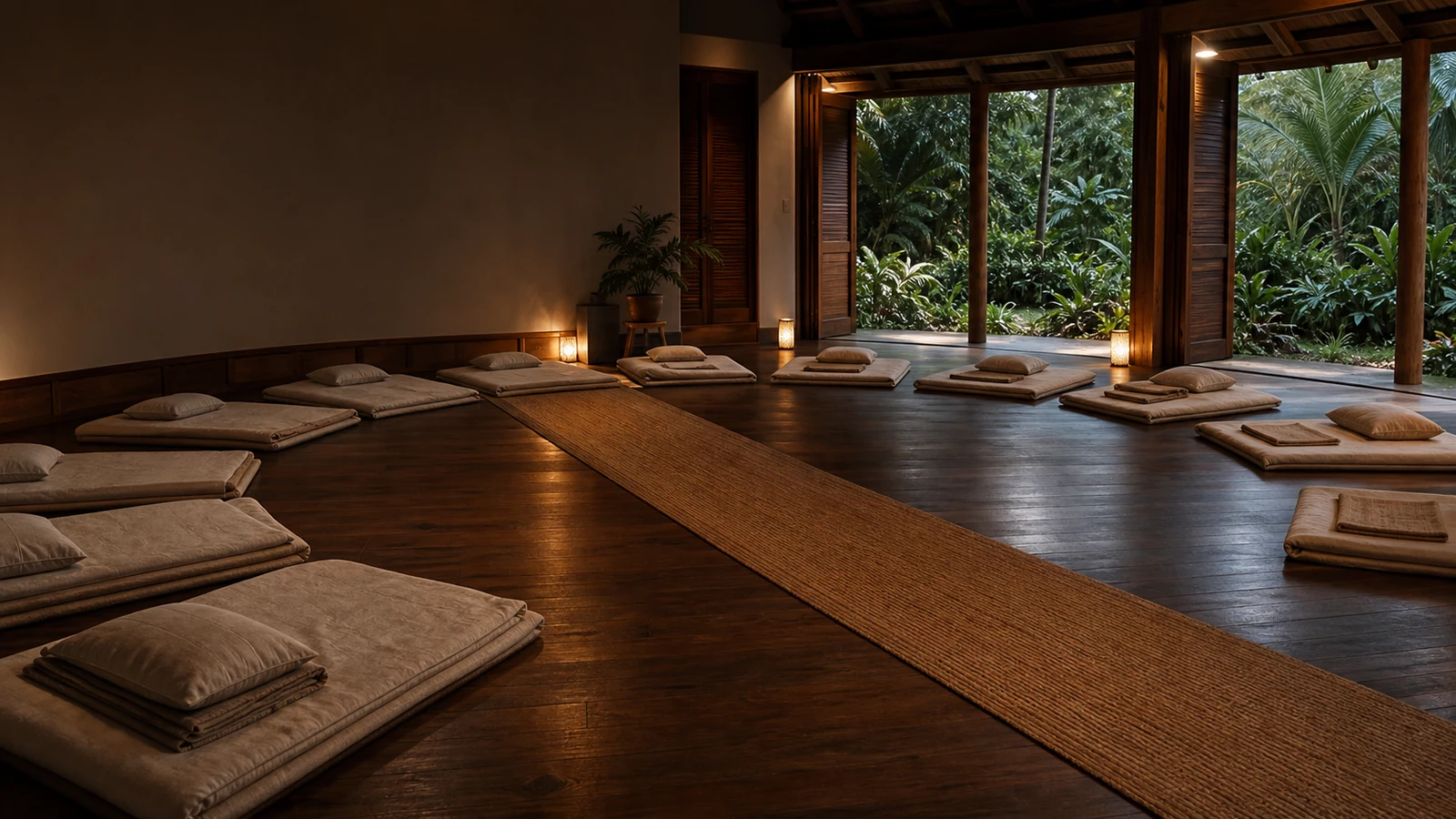
Participants usually have designated places to sit or lie down. A passage is left between them so that assistants can approach without fuss. Lights are often dimmed, but the room must remain suitable for safe movement. There should be water, hygiene products and the ability to calmly leave the main hall with an escort.
The beginning of the ceremony may include an opening speech, silence, singing, or music. In traditional contexts, songs may play a role in a local knowledge system. In a modern center, the music program sometimes consists of different traditions or recordings. External similarities can have different meanings, so the honest organizer explains the origin of the elements.
The experience of the participants does not begin at the same time and does not unfold according to the same pattern. Someone first notices bodily sensations, someone notices changes in attention or emotions, and someone does not feel the expected effect for a long time. Comparing yourself with your neighbors is not very informative at this point. Reaction depends on many factors and does not measure the "success" of the meeting.

What can happen during the main part
The main part may include silence, singing or a sequence of musical pieces. People can lie down, sit, cry, talk to a helper, or ask to go out. An organized format should not require everyone to behave the same unless it involves safety and respect for others.
Physical reactions may include nausea, vomiting, tremors, changes in pulse or blood pressure. The psychological course can range from calmness and vivid images to fear, confusion, or a sense of loss of control. Intensity does not equal benefit, and challenging experiences should not automatically be labeled as necessary cleansing.
The team must observe without intrusiveness and at the same time not miss the danger signals. This requires a sufficient number of sober assistants. Their job is to maintain orientation, assist with movement, assess changes in a participant’s condition within the limits of their training, and execute a predetermined response plan.
The participant should know in advance how to ask for help. In a dark room or during music, a quiet voice may go unheard, so the team sometimes agrees on a simple gesture or verbal signal. What is important is not the decision itself, but that it was explained before the beginning and really worked.
There should be clear boundaries of behavior in the space. Basic organizational arrangements include:
- do not touch other participants without their current consent;
- do not leave the designated area without notifying the team;
- do not photograph or record people in a vulnerable state;
- do not take over a trained assistant’s role when another participant needs help;
- report a sharp deterioration in physical or mental condition.
These arrangements are needed not to create a strict atmosphere, but for predictability. In an altered state, ambiguous signals and improvised "help" can be perceived especially acutely.
What does support look like in a difficult moment
Support begins with a short contact: the assistant introduces themselves, checks that the person can hear them and asks what they need. Sometimes a calm presence and orientation in place and time is enough. In other cases, it is necessary to monitor the physical condition or involve external help.
The professional team does not promise that every reaction can be managed only by talking, breathing or music. It recognizes the limits of its competence and has criteria for moving from ceremonial support to medical response. The answer "we can always manage ourselves" should raise further questions.
It is equally dangerous to attribute every fear to spiritual resistance, or to insist that a participant must remain in place against a clearly expressed need. Support does not take away a person’s right to be heard. Even during times of intense distress, the team should seek the least intrusive way to help and explain their actions.
How the ceremony ends
Organizers can mark the end with a word, a song, a change in lighting or a gradual transition to silence. However, formal closure does not mean that all participants have regained their orientation in the same way. The team must make sure that everyone can get to the rest area safely and knows where to find help.
Immediately after an intensive experience, it is not necessary to hold a long public discussion. A person may be tired, emotional or not ready to formulate conclusions in front of a group. Being able to remain silent is just as important as being able to communicate your condition briefly.
In the first hours, rest, a calm environment, and monitoring for disorientation are important. Do not plan to drive, hold difficult negotiations or make major decisions immediately after the ceremony. Getting back to normal is an individual process.
The following day, the program may include a group conversation or individual contact. This is no longer a continuation of the ritual, but the first opportunity to calmly describe the experience, separate observations from hasty interpretations and notice whether additional support is needed.
Why the actual process may differ from the description
Formats vary according to cultural tradition, group size, location and team preparation. Some formats center on live singing; others use silence or a selection of recorded music. In one center, the participants have separate rooms, in the other they stay in a common hall until the morning.
Difference alone does not make a format better or worse. The problem arises when the organizer hides important conditions or changes them after arrival. It is worth comparing the program in advance with materials about what is called a ceremony, how to evaluate the risks of ayahuasca and what are the factors of increased vulnerability. A description of the larger format is on the retreat page.
Specificity is a useful feature. The team can name the number of participants and assistants, the order of contact, conditions for night observation and a contingency plan. General words about "safe space" without answers to these questions do not give enough information.
Also ask for an explanation of what happens if the person decides not to participate after arrival. A mature program does not create pressure because of the money spent, the expectations of the group or the facilitator's authority. The ability to change a decision is part of voluntary participation. It is especially important when new information about the well-being, living conditions or behavior of the team appeared only on the spot.
What is known from research
Ethnographic and naturalistic publications describe ceremonies as structured social events with defined roles, music, support, and follow-up meetings. At the same time, most of the data refer to specific centers or groups and do not create a universal protocol.
Research on set and setting shows that expectations, group atmosphere, and context can be related to psychological changes. This does not invalidate the pharmacological effect, but warns against explaining the result only by the drink. The small sample size and self-selection of participants limit the breadth of conclusions.
Surveys about undesirable consequences record both short-term physical reactions and longer psychological difficulties in some respondents. Self-reports do not provide an accurate prognosis for an individual, but support the need for screening, follow-up, and access to care after completion.
Sources
- An observational study of a structured ceremonial format.
- A placebo-controlled study of the role of set and setting.
- A naturalistic study of retreat participants with a six-month follow-up.
- International survey on acute and long-term adverse effects.
- Qualitative research on consent and boundaries in altered states.