
Short answer
An ayahuasca ceremony is an organized meeting during which participants consume an Amazonian plant brew in a designated space with the participation of a guide or team. Its form depends on tradition, country and organizers: music, rules of interaction, duration and support may differ. The word "ceremony" itself does not guarantee quality, safety or the expected result, so specific conditions must be evaluated separately.
In everyday conversation, this word is sometimes used to refer to any group meeting with ayahuasca. In academic descriptions, it more often indicates a ritually organized context: defined roles, a sequence of actions, rules of space, music or singing, and a way to support the participants. It is important not to confuse these meanings. The same name can hide very different practices.
Therefore, it is more useful to ask not only "is this a ceremony", but who conducts it, how the team prepares the space, what happens in a difficult situation and how personal boundaries are protected. This approach respects tradition while asking for more than a label as evidence of quality.
What is called an ayahuasca ceremony
An ayahuasca ceremony is not the name of one standardized protocol. In various Amazonian communities, plant practices were formed in their own languages, knowledge systems, and social relations. Outside the Amazon, retreat, religious, psychotherapeutically oriented and mixed formats have been added to them.
For example, in one Shipibo center studied, ceremonies were conducted by several onanyabo, practitioners of the local tradition, along with Western facilitators. The authors described the sequence of meetings, singing and distribution of roles. This is valuable evidence of a specific adapted center, but not a template for all Shipibo communities, and even less a description of every ayahuasca ceremony in the world.
A modern organizer may use the word "ceremony" even if the meeting has little to do with a specific Amazonian tradition. The term itself does not answer questions about the team's education, prior screening, number of assistants, limits of contact, or availability of assistance. These characteristics need to be clarified separately.
What elements can be included in the ceremony
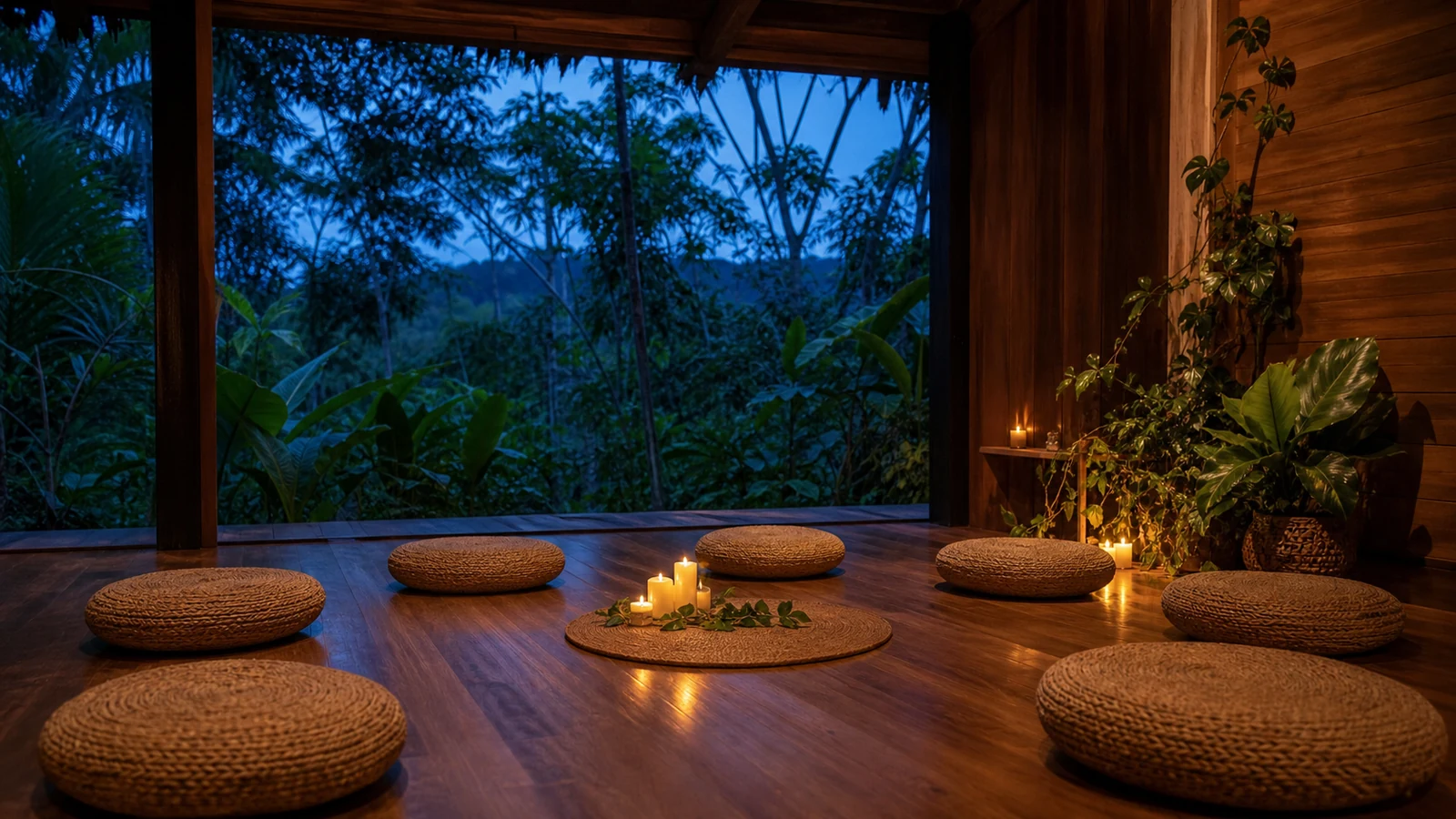
The most noticeable differences concern space and sound. Some participants sit or lie in a common room, and some have separate seats. In some traditions, the central place is occupied by icaros - songs performed by the practitioner; others use instruments, recorded music, silence, or a combination of these approaches.
A possible meeting structure includes an introductory reminder of the rules, quiet time, periods of music, an opportunity to ask for support, and a clear conclusion. This is a description of common organizational elements, not a how-to guide. The actual sequence depends on the practice of the team and the state of the group.
A responsibly organized format can include:
- preliminary conversation and collection of important health information;
- clear explanation of team roles and how to ask for help;
- agreements about silence, movement, privacy and physical contact;
- sufficient number of sober helpers available;
- clear way to end and follow up.
The presence of an item in the program does not show how well it is carried out. "Screening" can be a meaningful conversation with clarifications, or it can be reduced to a few formal questions. "Support" can mean a trained team with defined roles or just a promise to be there. Specific actions should be evaluated.
Why are the formats different?
This diversity has several sources. Amazonian practices do not form a single school; they varied between peoples, families, regions and historical periods. After the spread of ayahuasca beyond the borders of the region, the language of modern wellness, group work and psychology began to be added to the traditional elements.
Context also affects how a person explains experiences. One group may talk about spiritual images, another about memory, emotions, or the work of the nervous system. These explanations are not interchangeable scientific facts. They show the language in which the community gives meaning to the experience.
A small placebo-controlled study of group retreats found changes in some psychological indicators in both the ayahuasca group and the placebo group. It does not prove that the substance has no effect; instead, it shows that expectation and setting can be part of the observed outcome. Due to the small sample size and experienced participants, these data cannot be generalized to everyone.
Traditional origins and modern language of retreats
The word ayahuasca originates from the linguistic and cultural space of the western Amazon, but today it refers to various herbal preparations and practices. In some communities, the very name, composition and role of the songs differ. Therefore, the phrase "ancient traditional ceremony" without specifying the people, region and training lineage tells much less than it seems.
Modern centers often explain the experience in a language understandable to an international audience. The program may include group discussions, breathing or body practices, meditation, and individual counseling. They do not necessarily belong to the same tradition as ceremonial singing. An honest description separates the origins of the elements instead of giving the impression of a single unchanging ritual.
Cultural accuracy is needed not only out of respect for the people who maintain the practice. It helps the reader to understand which statements are a description of a traditional worldview, which are the facilitator's personal interpretation, and which are based on psychological or pharmacological research. When these levels are mixed, the symbolic explanation easily begins to sound like medical fact.
At the same time, traditional origin should not be judged only by external features: clothing, decor, song language or the number of plant symbols. Long-term training, relationships with a specific community, a way of transferring knowledge and a willingness to name the limits of one's competence are important. For a potential participant, this is a reason to ask clarifying questions, and not to demand spectacular "authenticity".
The role of team, space and interaction rules
The altered state can increase confusion, suggestibility and dependence on people around. Because of this, the team's role is not limited to music or symbolic authority. The participant needs to understand in advance who stays sober, who reacts to physical discomfort, how to call for help, and who to report discomfort to.
Consent and personal boundaries should be discussed beforehand. This especially applies to touching, body practices, private conversations and photos. Research by practitioners of psychedelic-assisted therapy does not describe ayahuasca retreats directly, but consistently emphasizes the vulnerability of a person in an altered state and the importance of prior arrangements.
A comfortable room alone does not make a ceremony safe. Access to water and toilets, the absence of dangerous obstacles, the ability to calmly call for an assistant, and an appropriate ratio of staff to participants are important. Beautiful photos of the venue do not answer these questions.

What the ceremony does not guarantee
An organized space does not make the reaction predictable. Beverage composition, individual sensitivities, health status, medications, sleep, and anxiety can alter the course of the experience. A previously pleasant ceremony also does not guarantee the same experience next time.
A ceremony is not a guarantee of insight, emotional relief, or lasting change. In naturalistic studies, people often report feeling better, but such samples are drawn from volunteers, and outcomes are influenced by expectations, group, rest, and follow-up support. An observed relationship does not establish what exactly caused the change.
Similarly, difficult experiences should not automatically be declared useful. Fear or disorientation can pass without consequences, but sometimes difficulties last longer. No one should be pressured to find a positive meaning in an unwanted reaction.
Separately, it is worth distinguishing the intention and the result. Intention can help frame an important question, but it does not guide the pharmacological response and does not guarantee that the experience will be about the chosen topic. For an organizer to promise an exact result in a single meeting runs counter to the known variability of experience and the limitations of research. Realistic expectations leave room for a neutral, ambiguous or difficult experience.
How to read the description of the ceremony before deciding
A promotional description usually talks about atmosphere, intention and possible experiences. Real understanding requires more specific answers. Start with how the team screens participants, what their roles are and what the team does in the event of an acute physical or psychological reaction.
It is useful to compare the description with materials about ayahuasca itself, known risks and factors of increased vulnerability. If you are still considering this format, the retreat page should be clear about the program, terms and conditions and how to contact the organizers with questions.
What is known from research, and what depends on tradition
Ethnographic and naturalistic works confirm that ceremonial practices can have ordered roles, singing, rules of space, and sequences of meetings. They also show that contemporary centers often combine local practices with facilitator support for international participants.
These studies describe a specific context well, but do not establish a universal format. The meaning of a song, silence, intention or symbol belongs to the cultural system in which they are used. A scientific paper may describe the practice and self-evaluations of the participants, but not establish every spiritual explanation as a fact.
Data on the results of retreats are mostly observational. Self-selection, expectations, and lack of a control group limit causal inferences. The most accurate position recognizes the possible personal significance of the experience and at the same time does not turn it into a promise for another person.
Sources
- An observational study of the Shipibo ceremonial format.
- An overview of the history, composition and modern research of ayahuasca.
- A placebo-controlled study of the role of set and setting in group retreats.
- A six-month naturalistic study of retreat ceremonies.
- A qualitative study of consent, touch and boundaries in psychedelic assisted practice.