What is ayahuasca - a short answer
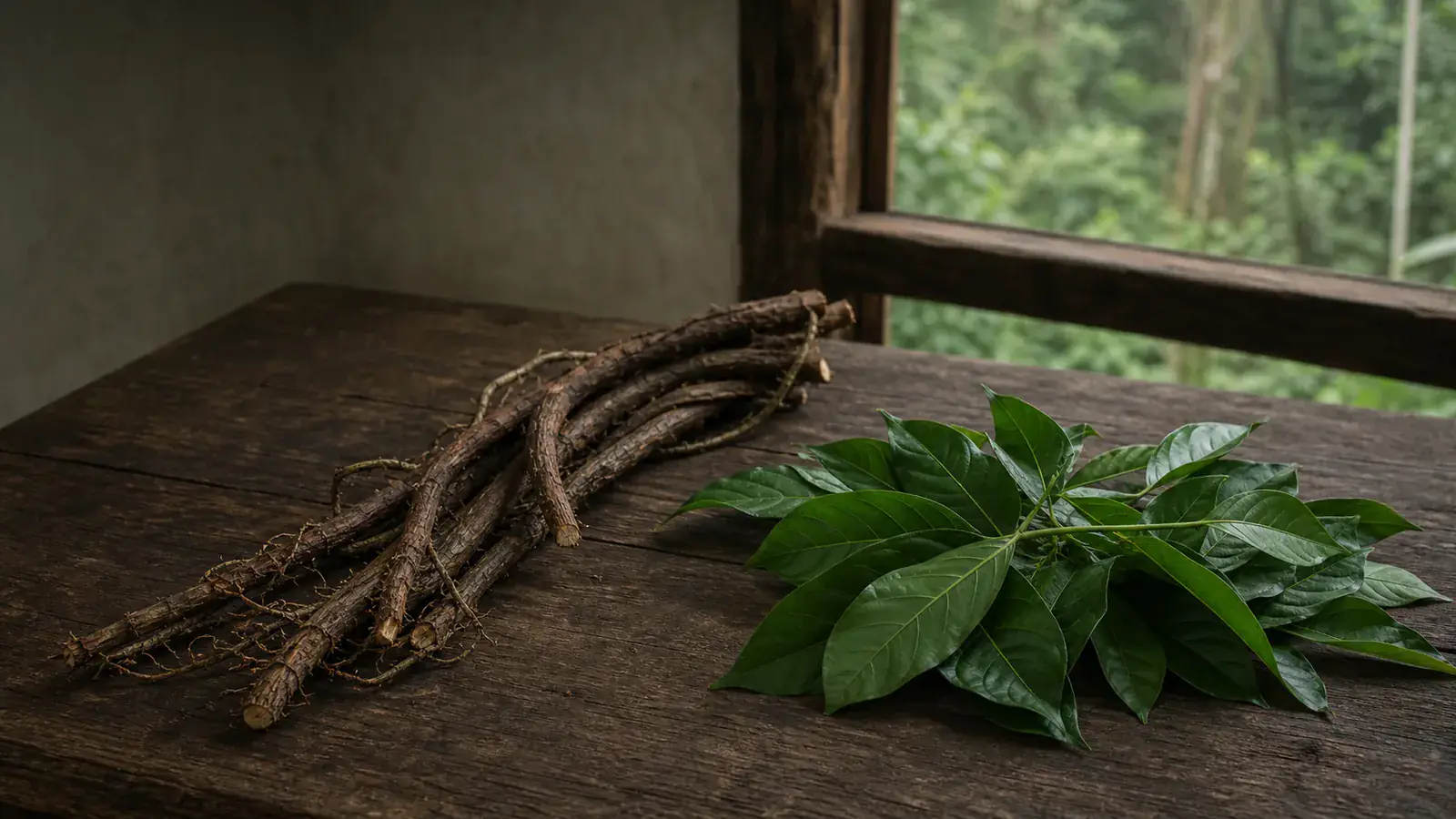
Ayahuasca is a collective name for psychoactive plant brews used in Amazonian traditions. The best-known version combines the liana Banisteriopsis caapi with a DMT-containing plant, specifically the leaves of Psychotria viridis, although the composition and cultural significance vary between regions and communities. The vine contains beta-carbolines, which temporarily inhibit the enzyme monoamine oxidase A, and the leaves may contain DMT. Physical and psychological risks exist.
Ayahuasca is not a standardized medicinal product. Different brews can have different compositions, and the subjective experience can include vivid images and strong emotions, as well as fear, confusion, nausea, vomiting or dangerous reactions. Early mental health research looks promising, but does not yet provide grounds for calling ayahuasca a proven treatment for a specific disorder.
On the Internet, this word sometimes refers to everything from a traditional Amazonian decoction to capsules, tinctures, and mixtures with unknown impurities. The name itself is not enough to assess the risk. It is necessary to know the exact botanical composition, laboratory results, preparation conditions and other substances that a person takes. In the absence of these data, the honest answer is not to guess, but to acknowledge the uncertainty.
Where does ayahuasca come from?
The word "ayahuasca" comes from the Quechua language; in the popular translation it is associated with the "liana of the spirits" or "liana of the ancestors". This is just one of the names. In Brazil you can find "daime" or "hoasca", in Colombia - "yagé", and some indigenous peoples use their own terms. Behind each name is not just a drink, but a local system of knowledge: methods of harvesting plants, songs, rules of conduct, the role of a guide and ideas about health.
Archaeological findings testify to the ancient ritual use of psychoactive plants in South America, but the exact date of the appearance of the modern combination of plants cannot be established. The story, often retold today as one continuous tradition, is actually more complex. Practices changed through exchange between peoples, colonization, missionary work, migration to cities, and the emergence of syncretic churches in the 20th century.
Global popularity has brought a new problem: Amazonian concepts are easily detached from the context and turned into a universal product. A proper conversation about ayahuasca should acknowledge the contributions of indigenous communities, not treat all traditions as the same, and not use the word "shaman" as an automatic sign of competence.
At the same time, tradition is not a museum exhibit. Indigenous practices continue to change, and the people who maintain these traditions respond differently to tourism, research and international dissemination. Some communities see this as an opportunity to support culture, while others talk about misappropriation of knowledge and overharvesting. This discussion is important: the ethics of the event is not only about the safety of the guest, but also about the origin of the plants, fair compensation for work and the right of people to control their own cultural heritage.
Which plants are used in ayahuasca?
In the most frequently described combination, the base is a woody vine Banisteriopsis caapi. It contains harmine, harmaline and tetrahydroharmine - beta-carboline alkaloids. The second component is often the leaves of the shrub Psychotria viridis known as chacruna; it may contain N,N-dimethyltryptamine, or DMT. In other regions, instead of chacruna, for example, Diplopterys cabrerana is used.
Even when the names of the plants match, the concentration of active substances can vary significantly due to the species, age and part of the plant, place of cultivation, storage and method of preparation. Adding other plants makes the composition even less predictable. Therefore, conclusions from the study of a standardized laboratory sample cannot be automatically transferred to every ceremonial brew.
How ayahuasca works
If DMT is taken orally on its own, the enzyme monoamine oxidase A usually breaks it down rapidly in the gut and liver. Beta-carbolines from the vine temporarily inhibit this enzyme. As a result, DMT can enter the systemic circulation and interact, in particular, with serotonin 5-HT2A receptors. This is a simplified explanation: both groups of substances have a wider spectrum of action, which is still being studied.
The onset, duration, and intensity depend on the composition of the drink, human physiology, food, other substances, and context. Changes in visual perception, sense of time, attention, memory and emotions are often described. At the same time, an increased heart rate and blood pressure, tremors, sweating, nausea, vomiting or diarrhea are possible.
The mechanism also explains part of the risks. Monoamine oxidase is involved in the metabolism of many compounds, so its inhibition can change the response to medications. It is especially dangerous to independently combine ayahuasca with drugs that affect serotonin, stimulants and certain other substances. "Natural" origin does not make the pharmacological interaction weak.
Popular explanations often attribute the effect to DMT alone, but such a model is incomplete. Beta-carbolines do not simply "pave the way" for another molecule: they themselves interact with the nervous system, and the ratio of components varies from sample to sample. Researchers are also studying changes in brain network connectivity, emotional processing, and neuroplasticity. These laboratory indicators are interesting, but they do not in themselves prove an improvement in health and do not predict how a particular person will feel.
What the experience can be like
Descriptions of the experience are necessarily subjective and incomplete. Some people recall complex geometric images, memories, a strong sense of connection, or a reevaluation of life events. Others experience panic, disorientation, shame, fear of death, or reliving traumatic episodes. Sometimes the expected visual effects are almost absent, while physical discomfort and exhaustion dominate.
Nausea and vomiting in many traditions have ritual significance and are interpreted as purification. From a medical point of view, these are physiological reactions that can lead to dehydration or aspiration if a person is unconscious or lying in a dangerous position. A cultural explanation does not negate the need for practical safety measures.
The experience is influenced by the "set and setting": mental state, expectations, relationship with the group, music, lighting, the facilitators' behavior and sense of control. After an intense night, there is sometimes relief and clarity, but other times insomnia, anxiety, emotional instability, or difficulty getting back into a normal rhythm. Integration, understood as calm reflection without imposing a “correct” interpretation, is more important than loud promises of instant transformation.
The memory of an event also changes over time. What seems like a definitive answer in the morning may look like a metaphor or a stress response a few weeks later. It's good not to make big financial, family, or medical decisions based on a single night's experience. If the experience revealed a painful topic, it is safer to discuss it with a specialist who does not depend on the organizers and does not insist on a single spiritual explanation.
Participant testimony can help understand the spectrum of experiences, but does not predict another's outcome. Positive stories are more likely to be published and shared, while people may remain silent after difficult reactions due to shame or peer pressure. Therefore, a review is a personal story, not proof of the safety, effectiveness or professionalism of a particular retreat.
Risks and contraindications
The most frequent acute adverse reactions are nausea, vomiting, diarrhea, headache, tremors, dizziness, increased blood pressure and pulse. Psychological reactions may include severe anxiety, panic, paranoia, disorientation, and behavior that is dangerous to self or others. Rare events are more difficult to assess: commercial ceremonies generally lack a consistent system for recording adverse events, and the composition of drinks is often unknown.
Some clinical reports have linked psychotic or manic episodes to ayahuasca use, especially in the presence of a personal or family history of psychosis or bipolar disorder. This does not mean that a reaction is inevitable, but is a good reason for a professional risk assessment. Pregnancy and breast-feeding, uncontrolled cardiovascular disease, seizure disorders, and severe acute psychiatric symptoms also require special caution and are usually grounds for exclusion.
Medicines and substances
Antidepressants, stimulants, some migraine relievers, cough suppressants, and other medications can interact with MAO-A inhibition or the serotonin system. Do not stop prescribed medication on your own for the sake of participation.
Context and supervision
It is not only substances that pose a risk. The absence of a medical plan, locked rooms, water or fire nearby, violations of sexual boundaries and the inability to leave the event are independent danger signals.
If you experience high fever, severe confusion, convulsions, loss of consciousness, chest pain, severe agitation, or symptoms that persist after use, seek immediate medical attention. Tell medical professionals honestly what you took, when you took it, and which other medications or substances were involved.
What is known from research
Scientific interest in ayahuasca has grown significantly. Observational studies and small trials have reported reductions in symptoms of depression, anxiety or problematic substance use in some participants. At the same time, observations do not prove causality: people themselves choose ceremonies, expect change, and often receive additional support from the community. This can affect the result no less than pharmacology.
Systematic reviews draw attention to small samples, different preparations and settings, short follow-up and risk of publication bias. There are still few controlled clinical trials. Some studies examine a single administration in carefully selected participants under medical supervision - this is significantly different from a commercial ceremony with an unknown composition.
Confirmed
Preliminary data
Not yet known
- Who might experience lasting benefits, and under what conditions.
- How laboratory results are transferred to decoctions with a non-standard composition.
A review of registered trials in 2026 shows that the field is developing, but the results of many projects have not yet been published. The most accurate position today is that there is enough data to support quality research, but not enough to replace standard diagnosis and treatment.
It is also important to distinguish between statistical and clinical significance. A change in questionnaire scores after one session does not always mean a sustained recovery in performance, relationships, or quality of life. A more reliable study has a predetermined protocol, a control group, a transparent record of dropouts, and a sufficient follow-up period. For psychedelics, it is difficult to ensure complete blinding: the participant usually guesses whether they have received the active substance, and expectations influence responses.
A separate issue is who is excluded from the study. People at high risk for psychosis, unstable heart conditions, or complex drug combinations are often screened out early. Therefore, relatively good tolerability in a selected group does not mean the same safety for everyone. In advertising, this limit is lost, although it is precisely this limit that determines how carefully conclusions can be transferred outside the laboratory.
A ceremony and a retreat are not the same thing
A ceremony is usually a separate event with a defined ritual or facilitated format. A retreat is a larger program of one or more days that may include accommodation, meals, preparatory meetings, several ceremonies and integration. These words are not professional standards and do not in themselves confirm the quality of the service.
It is worth distinguishing the traditional context of a specific community from a modern wellness product. An organizer may sincerely follow a particular tradition, but that is no substitute for medical screening, an emergency plan, consent rules, and transparency about the brew’s composition. Conversely, comfortable accommodation and professional photos do not prove the competence of the team.
How to recognize a responsible approach
Reliability is better assessed not by the charisma of the host, but by specific procedures. Before any decision, ask for a written explanation of who is doing the screening, what conditions and medications are grounds for refusal, who is providing first aid, how local emergency services are contacted, and who remains sober throughout the event.
- The composition and origin of substances are mentioned directly, without evasion and "secret additives".
- Participation is voluntary; you can refuse or leave the space without punishment or public pressure.
- The rules of touching, privacy, photos and sexual boundaries are fixed before the event.
- The organizer does not ask participants to stop prescribed treatment and does not promise to cure a condition.
- There is a realistic post-crisis support plan, not just a general group chat.
- It is known how many participants each sober assistant supports and how the safe space is arranged.
Red flags include the promise of a predetermined outcome, devaluing questions, hidden fees, no access to doctors, romantic or sexual relationships between the host and participants, no health questionnaire, and the explanation of any deterioration as "ego resistance." The responsible team recognizes the limits of its competence and can decline an application when the risk is too high.
Sources and review date
The material is based on peer-reviewed review articles, clinical and observational studies. The list is not exhaustive and will be supplemented after editorial review of new data.
- ayahuasca: History, Pharmacology, and Research Directions (PubMed, 2024).
- Review of ayahuasca Research in Humans (PubMed, 2016).
- Toxicological aspects and potential interactions (PubMed, 2019).
- Systematic Review of Adverse Events (PubMed, 2024).
- Review of Psychotic Disorders Associated with DMT and ayahuasca (PubMed, 2017).
- Review of Pharmacology, Safety and Limitations of Research (PubMed, 2024).
- Meta-analysis of Mental Health Outcomes (PubMed, 2024).
- Living Systematic Review of Psychedelic Interventions (PubMed, 2025).
- Review of Registered Clinical Trials (PubMed, 2026).
- The Cultural Context of Vomiting in Ceremonies (PubMed, 2021).
- Ethnobotany and the Limits of External Classification (PubMed, 2020).
Important: this material is informative and does not constitute medical advice. It contains no instructions for preparation, dosage or purchase. If you are taking medication or have a physical or mental illness, discuss the risks with an independent, qualified professional.
Editorial review: July 13, 2026. The next review is when new systematic reviews become available or no later than July 2027.