Short answer
The most commonly described ayahuasca preparation combines the vine Banisteriopsis caapi, which contains the beta-carbolines harmine, harmaline, and tetrahydroharmine, with a DMT-containing plant, often Psychotria viridis. However, the name does not imply a fixed formula: plant species, alkaloid concentrations, and additional components vary between regions, traditions, and individual specimens. The exact composition can be established only for each specific material studied.
Banisteriopsis caapi: what the vine contains
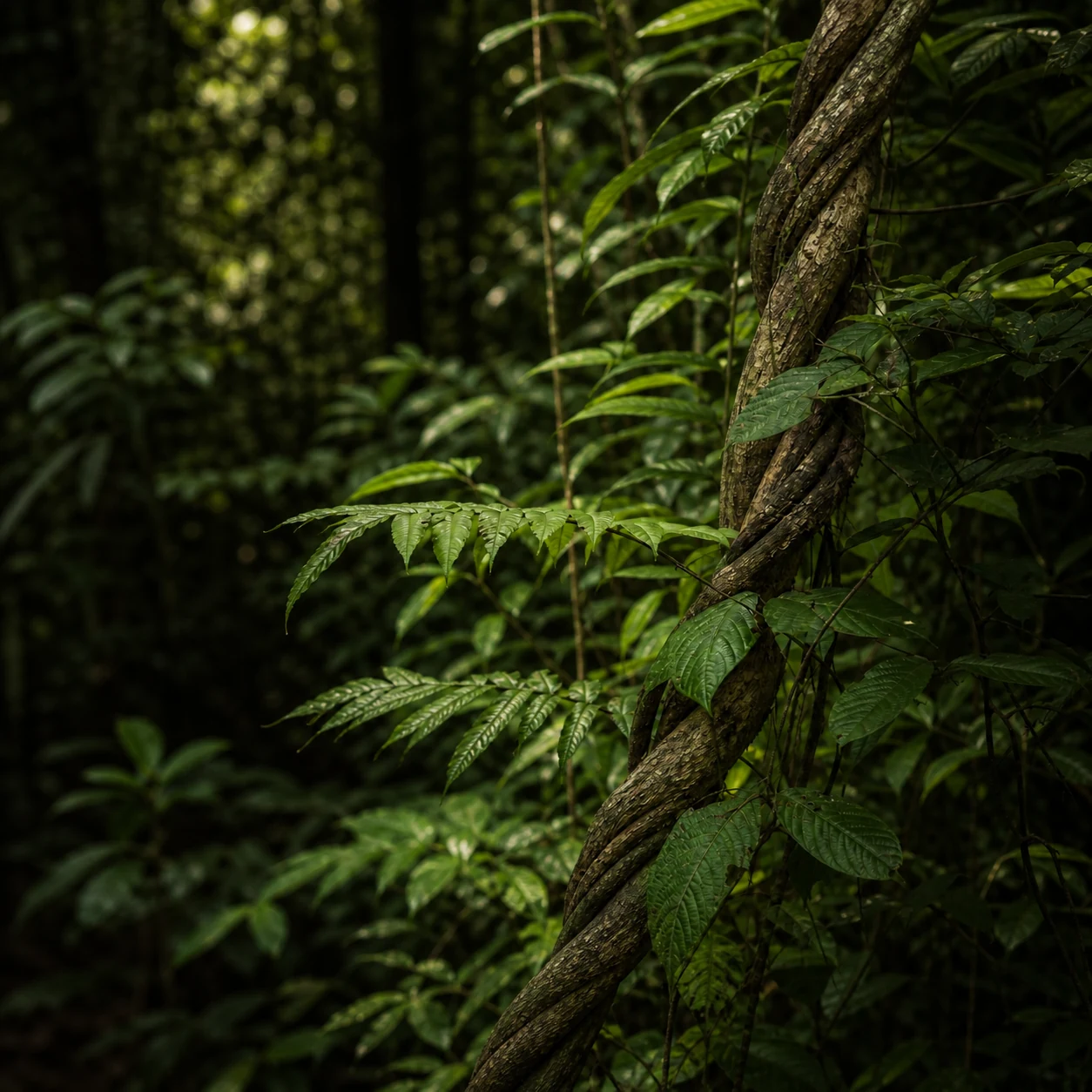
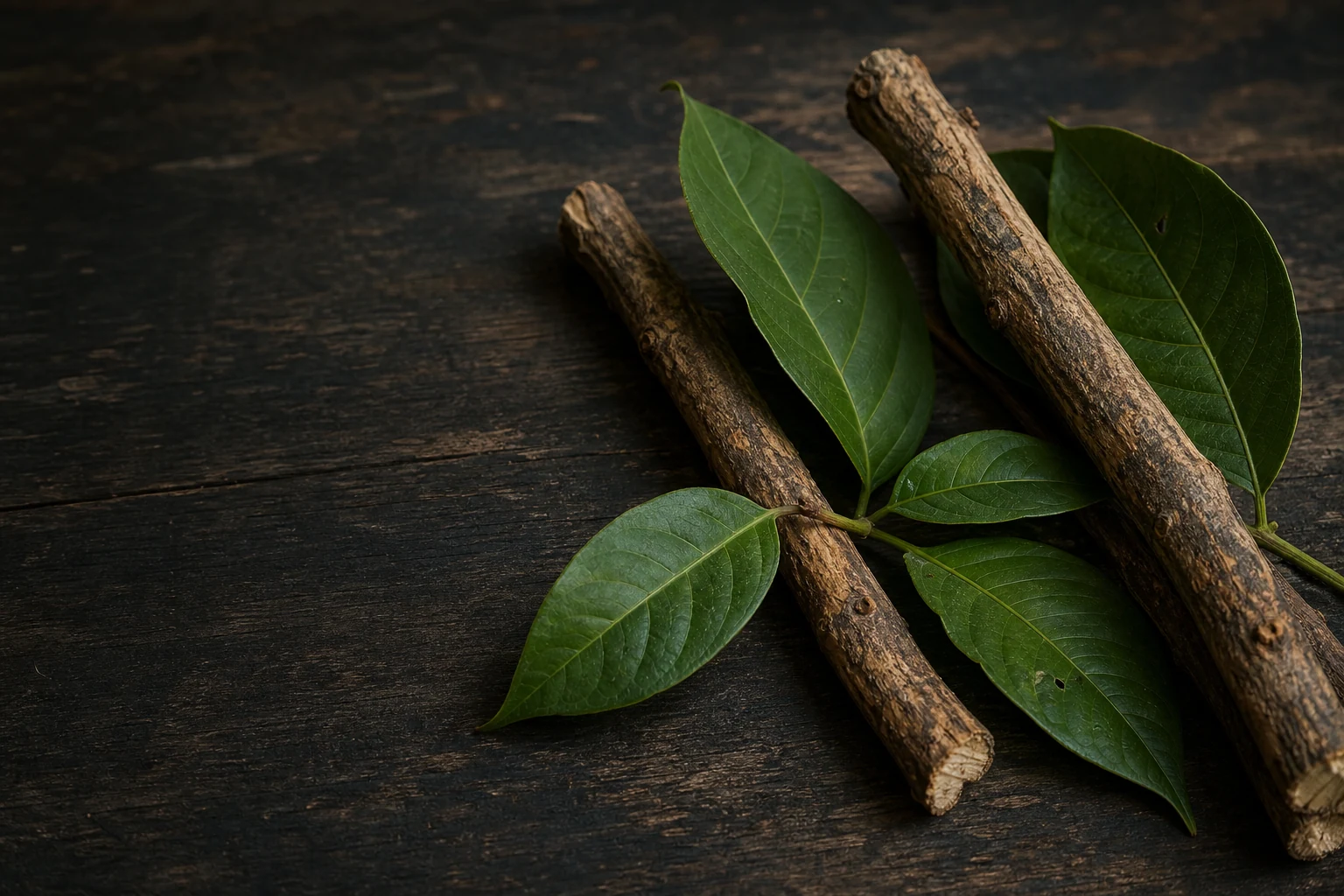
Banisteriopsis caapi is a woody vine of the Malpighiaceae family, common in Amazonia. In scientific descriptions, it is often called the basic component of ayahuasca. For accuracy, it is important to separate the plant and individual substances: the vine is a complex biological material, not a container with one isolated alkaloid.
The most frequently mentioned alkaloids are harmine, harmaline and tetrahydroharmine. Harmine and harmaline can temporarily inhibit monoamine oxidase A, an enzyme involved in the metabolism of monoamines. Tetrahydroharmine has a different pharmacological profile and should not be assumed to act in the same way. The ratio of these substances varies, so the phrase "contains beta-carbolines" is more accurate than assuming the same concentration.
The chemical profile can be influenced by botanical identity, plant part, growing conditions, age, storage and processing. Even samples with the same label are not necessarily equivalent. The overview data help to understand the general mechanism, but do not reveal the composition of an unknown brew.
Psychotria viridis and other DMT-containing plants
Psychotria viridis, or chacruna, is a shrub whose leaves may contain N,N-dimethyltryptamine, DMT for short. It is this plant that most often appears in popular explanations. However, some regions and traditions use other botanical sources, in particular Diplopterys cabrerana. Changing the species not only changes the name of the ingredient, but also the overall chemical profile.
The content of DMT in plant tissue is not a constant number. The result of the laboratory measurement refers to the examined sample, and not to the entire species under any conditions. In addition to the main substance, the plant contains many other compounds, most of which have been studied far less extensively in the context of the finished decoction.
Because of this, it is incorrect to describe ayahuasca simply as "DMT in plants". This reduction ignores the role of beta-carbolines, raw material variability, and cultural context. It also creates a false analogy between a botanical decoction, an isolated substance, and a standardized research formulation.
Why the composition of different decoctions is not the same
Ayahuasca is a category, not a standardized product. Ethnobotanical sources describe different methods of classification and local names, which do not always coincide with the external idea of one universal mixture. For some communities, the liana itself may be decisive, for others, a combination of plants or a ceremonial context.
Variability begins even before the finished decoction appears. The plant can be misidentified; different parts have different compositions; storage changes raw materials. When several plants are combined, the sources of uncertainty increase. Additional impurities may have their own pharmacological effects or alter tolerability.
That is why the research conclusion should be read together with the methods. Did the authors analyze the sample? What alkaloids were measured? Was the composition standardized? If this information is missing, an accurate comparison with another study or a real sample is not possible.
What do DMT, harmine, harmaline and tetrahydroharmine mean
DMT is a tryptamine compound that interacts with several serotonin targets. When taken orally, it is usually rapidly metabolized by monoamine oxidase A. The presence of a substance in a plant alone does not describe the availability, duration, or intensity of the effect.
Harmine and harmaline belong to beta-carbolines and can inhibit MAO-A. This helps explain why the combination of plants has a different profile than DMT-containing leaves alone. At the same time, this mechanism is important for understanding potential interactions with other substances. Tetrahydroharmine is also a beta-carboline, but its contribution should not be described as an exact copy of harmine.
The names of the alkaloids are useful for reading research, but do not turn a complex concoction into a simple sum of four components. Pharmacokinetics depends on concentrations, individual metabolism, sample matrix and other factors. A general explanation of the mechanism is not an individual prediction.
What composition analysis cannot predict
A well-conducted laboratory analysis can answer which selected substances are detected and in what concentration in a particular sample. It is useful for checking botanical assumptions, comparing batches and detecting some impurities. But no limited test automatically covers all possible compounds.
Even a more complete profile does not predict the experience of a specific person. Reaction is influenced by physical condition, mental vulnerability, other substances, context, and expectations. Two people may react differently to the same preparation, and the same person may react differently at different times.
The analysis also does not confirm the cultural authenticity, the competence of the organizers or the quality of the support. Chemical analysis answers chemical questions. It does not replace an assessment of the wider context and does not make the outcome entirely predictable.
What to check in the description of a specific sample
A reliable description is not limited to a generic name. It distinguishes botanical identification, chemical analysis, specimen provenance and inference limits. This helps not to transfer the data of one study to all decoctions. For more context, read separately what the different names mean, how the components are related to the mechanism of action, and why the composition does not predict a specific effect.
- which plants are named and how they were identified;
- which substances were measured and by which method;
- whether the material was the same for all participants;
- whether the conclusion applies only to the sample studied.
What is confirmed and what remains unknown
It is well established that the most commonly studied preparations contain beta-carbolines from B. caapi and DMT from another plant, often P. viridis. The main metabolic pathways of these alkaloids are known, and modern analytical methods allow measuring them in specific samples.
The composition of the material described only by the common name is much less defined. Without botanical verification and analysis, species, concentrations, or impurities cannot be known. There is also limited data on the long-term effects of different, non-standardized combinations.
Reviews help to see repeatable results but combine studies using different preparations and methods. The correct conclusion sounds cautious: we know the basic components of the often described forms, but we cannot infer the exact composition of each decoction by name.
How to read a composition statement
The phrase "contains DMT" answers only the first question. It does not tell us how much of the substance was in the plant, how much remained in the finished sample, what other alkaloids were present, and by what method all this was determined. If the author goes on to make a precise prediction of the effect, there is a gap between the data and the conclusion.
A more reliable description identifies the exact botanical species, explains the origin of the specimen, and gives the analytical method. For research involving humans, it is also important to know whether all participants received the same standardized material. Without this information, it is difficult to understand whether the differences between people are due to individual response or to unequal composition.
The words "core component" also need context. They can mean the largest mass fraction of plant material, the highest measured concentration of an alkaloid, or a substance that the author considers to be the main one for a certain mechanism. These are different statements. In a well-reported publication, the units of measurement and the object of comparison are stated directly.
The certificate of analysis should be read not as a quality mark in itself, but as a document with a defined scope. You need to see the name of the laboratory, the date, the sample identifier, the list of tested compounds, the method and the limit of detection. The absence of a substance in the short list of results may mean that it was not searched for at all.
Botanical identification and chemical testing answer related but different questions. The first establishes the plant by morphological or genetic characteristics. The second measures selected molecules. The name of the species does not guarantee a specific concentration, and the alkaloid found does not always prove from which plant it comes.
In a popular text, it is impossible to reproduce the entire laboratory report, but it is possible to state clearly how precise the information is. The wording "found in the examined sample" is more accurate than "ayahuasca always contains". And the words "most frequently described combination" leave room for ethnobotanical diversity without turning it into chaos.
Finally, composition does not equal quality of experience. Even a fully known substance profile does not assess the psychological environment, the limits of interpersonal interaction, or the readiness for unpredictable reactions. Chemical transparency is necessary, but it is only one part of a responsible description.
Why the plant guide does not give a ready answer
A botanical reference book does a good job of describing the species, range, and characteristics, but usually does not establish a profile of a particular raw material. The plant is formed under the influence of soil, climate, age and storage method. Even the correct species name leaves a wide range of possible concentrations. Therefore, it is incorrect to transfer the average number from one publication to another material. Caution here is not a formality: it does not allow you to turn the measurement of one sample into an allegedly accurate characterization of a whole category of heterogeneous preparations.
Similarly, the list of traditional names cannot be read as a dictionary of exact synonyms. A single name may encompass several local variants, and similar names may have different meanings in neighboring communities. An ethnobotanical source is needed not to find a universal formula, but to understand who uses the term, where and in what context.
The best answer to the composition question combines three levels: botanical identity, chemical analysis, and a clear description of the origin of the sample. If any of these elements is missing, the conclusion must explicitly preserve this uncertainty.
Such caution generally helps the reader to distinguish an established fact from a convenient but untested generalization about the entire category.