
Short answer
Preparation for ayahuasca begins with an honest medical screening, an accurate list of medications and a discussion of risks with a qualified specialist. Next, you need to check the program, get enough sleep, arrange transport so you do not have to drive after the ceremony, agree on personal boundaries, and allow time for recovery. Do not stop prescribed treatment on your own or assume that strict restrictions guarantee the result you hope for.
Preparation is often reduced to a list of prohibitions or "cleansing". This approach distracts from the decisions that really change the conditions of participation: whether the team has full information, whether the interactions are clear, whether the person will be rested and how they will get home.
Good preparation does not make the reaction predictable. It reduces the number of unknowns and allows early withdrawal if new data indicates an increased vulnerability or the program does not meet the stated conditions.
What does it mean to prepare in practice
Preparation for ayahuasca is a decision-making process, not a ritual you must complete once you start. At each stage, there may be a reason to pause: a change in health, a new drug, lack of sleep, an unclear response from the team, or a different program than was announced.
Start by gathering information in one place. Record diagnoses, recent acute conditions, allergies, surgeries, medications, over-the-counter medications, and supplements. For each medication or supplement, give the exact name, not just "for blood pressure" or "for sleep". This lets the specialist assess the actual substance rather than guess.
Separately record the contact of a person who knows your condition and can help after your return. This is not necessarily a retreat participant. It is important that they know the dates of the trip, the method of communication and when to expect a message.
Health, medication and professional assessment
Ayahuasca contains components that affect monoamine systems, so interactions cannot be judged by a simple do/don't list. The active substance, combinations, cardiovascular and nervous system status, psychiatric history, and recent treatment changes are important.
The organizer must collect information, but must not replace the doctor. If there is a question about compatibility or discontinuation of therapy, consult a professional who knows your history. Do not stop medication on your own: A sudden change can have its own risks, and there is no single waiting period that applies to all medications.
Notify the team of changes that have occurred since you completed the questionnaire: infection, injury, panic episodes, insomnia, new prescription, or use of other psychoactive substances. Screening is not a one-time permit; confirm that the information is still current before the trip.
Materials on ayahuasca–drug interactions and factors that increase vulnerability will help shape questions, but are not a substitute for an individual assessment.
Sleep, physical demands and travel
A long flight, a change of time zone and a sleepless night can significantly change the physical and emotional state. Don't plan to arrive at the last minute if it can be avoided. Allow for traffic delays, acclimatization, and an unhurried conversation with the team.
Lack of sleep itself can increase anxiety, irritability and difficulty concentrating. Trying to "prepare" with grueling fasting, excessive training, or long night practices can worsen the initial condition. Maintain your usual routine as much as the trip allows.
Decide in advance who will drive after the ceremony. Even if the formal part is over, fatigue and residual feelings may persist. An early departure that cannot be changed creates pressure and leaves less time to assess how you feel.
What conditions need to be clarified before arrival
Ask for the program, accommodation rules and answers to important questions in writing. In particular, check the size of the group, the number of sober assistants, languages spoken by the team, night shifts, transportation and early check-out procedures. If the terms change, you can compare them with what you agreed to.
The practical list should include:
- organizer's contacts, addresses and transfer plan;
- room conditions, access to water, toilet and rest area;
- the way to call an assistant and the availability of translation;
- boundaries of touch, photos, private conversations and group sharing;
- communication channel and response time after return;
- how to opt out of an activity or leave the program.
A complete list of criteria can be found in the article "How to choose an ayahuasca retreat". Do not leave critical questions until the introductory meeting: in a group and after a long journey, it is more difficult to insist on clarifications.
Intention without a fixed script
People often formulate an intention, a topic they want to focus on. This can help describe motivations and discuss expectations. However, an intention cannot control the experience or guarantee a particular answer. The more fixed your expectations, the easier it is to perceive a neutral or difficult experience as a failure.
Ask yourself a few simple questions: why is the decision relevant now, what are the results you expect, what will you do if they don't happen, and who will support you when you return. Being prepared for uncertainty is more useful than trying to convince yourself that there should be no fear.
Don't take promotional stories as predictions. Reviews are selected, and people with mixed experiences may be less likely to talk about it publicly. Leave room for an ordinary, contradictory, or unpleasant response without the obligation to call it transformative.
What to pack and how to retain your independence
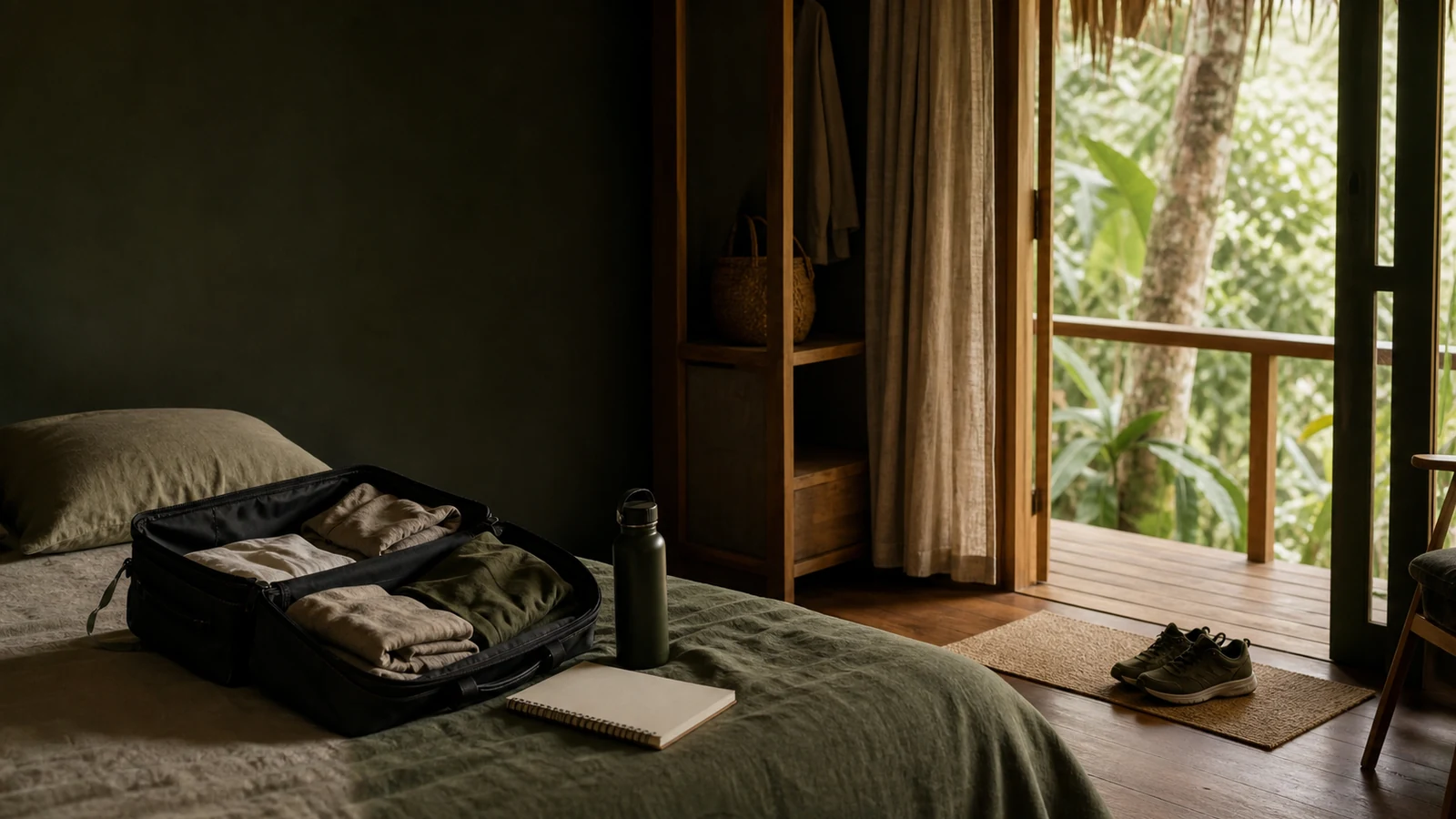
Focus on the climate, center rules and actual living conditions. Comfortable clothing, a supply of dry items, the necessary hygiene products, protection from the weather, a flashlight and a charged communication device are more useful than symbolic items. Check that there is constant electricity and where documents can be stored safely.
Do not hand over original documents to the organizer without clear need. Keep access to your own money in case you need to change your travel plans and a contact person outside the program. The possibility of leaving must be real, not just theoretical.
If the team asks to give up the phone, specify the duration and method of urgent communication. Silence can be part of the program, but the participant must know how to contact loved ones or outside help if needed.
Prepare the return, not just the trip
If possible, keep your schedule light for the first few days after you return. Sleep, regular meals, a calm environment and short contact with a trusted person help to assess the condition without hasty conclusions. Do not plan important decisions, public statements or difficult conversations right away.
Determine in advance where to turn if anxiety, insomnia, disorientation or other difficulties persist. The organizer can be one of the contacts, but not the only one. Write down the details of your doctor or psychotherapist and your local emergency room.
On the retreat page check what is included in post-program support. Ask what “integration support” includes: its format, the number of sessions, who provides it and the limits of the service.
What preparation cannot guarantee
Even carefully executed steps do not predict the content, intensity or emotional meaning of the experience. A prepared person may feel fear, nausea, disappointment or lack of expected changes. This does not prove that they were "poorly prepared" and does not give the organizer a reason to shift all responsibility onto them.
Similarly, preparation does not turn a retreat into a treatment with a guaranteed result. If the motivation is related to a specific diagnosis or acute crisis, it is important to maintain contact with professional help. Don't put off proven methods because of the promise of quick transformation, and don't use participation as a test of personal courage.
Strict compliance with symbolic requirements is also no protection against pharmacological reactions. The organizer may explain certain restrictions by cultural tradition or rules of cohabitation. This should be distinguished from medical advice. Ask to be told directly the reason for each requirement, and don't let spiritual language cover up the lack of justification.
Preparation does not end at the moment of arrival. Check your own condition during the program: whether you can sleep, whether the instructions are clear, whether you feel pressured and whether you can contact someone outside the group. The ability to change a decision remains more important than the willingness to follow through on the original plan.
Finally, no list can replace the quality of the relationship with the team. If an honest response is met with condemnation, an attempt at persuasion, or a spiritual explanation instead of clarification, this is new information about the format. It has the same weight as the application form, program or photos of the center.
Before you travel, do a short double-check: whether the situation has not changed, whether the transport and contacts remain current, whether you have copies of the arrangements and whether a trusted person knows your plan. Check what may have changed since you completed the questionnaire or paid. If the answer to an important point is already different, re-discuss the decision with the team and the relevant specialist before the program begins.
What is confirmed, and what remains speculation
Data on ayahuasca confirm pharmacological activity and the possibility of interactions, and surveys record acute physical and longer-term psychological difficulties in some people. This justifies screening, an accurate list of medications and substances, and follow-up after the event.
Naturalistic studies of retreats show associations between participation and changes in self-reported well-being, but do not establish the best diet, length of preparation, or one-size-fits-all ritual. Expectations and circumstances can also influence the outcome. Therefore, strict rules that are presented as a scientific guarantee need a separate source.
The best-supported preparation steps are the usual ones: up-to-date health information, professional assessment of interactions, adequate sleep, transparent logistics, voluntary participation, and a care plan.